A home office decision error is a mistake in an immigration refusal or other Home Office decision, such as overlooked evidence or the wrong application of the immigration rules, and it can often be challenged through administrative review, an appeal or judicial review. Which route applies depends on the type of application you made and what your decision letter says, and the deadlines are short.
At Axis Solicitors, our immigration team regularly reviews refusals where a Home Office decision error appears to have occurred. If you have received a refusal and believe the decision is wrong, including under the EU Settlement Scheme or in other immigration applications, read on.
This guide explains how to spot common errors, check your refusal letter, understand the evidence you may need, compare the available challenge routes, and take the right next step to protect your immigration position.
What Counts as a Home Office Decision Error?
A Home Office decision error is a mistake made by the decision maker (the caseworker who assessed your application), either in the facts or in how the law was applied. It is not the same as simply disagreeing with the outcome.
The Home Office calls a factual or procedural mistake a case working error. Examples include overlooking relevant evidence you submitted, applying the wrong immigration rule, or refusing for missing documents you had in fact provided.
Common Examples of Caseworking Mistakes
-
Evidence overlooked: supporting documents were uploaded or sent with your immigration application but the refusal letter says they were missing. A refusal may also be challengeable if the caseworker failed to apply evidential flexibility when assessing the evidence already submitted.
-
Wrong immigration rule: the decision applies requirements from a different route or an outdated version of the immigration rules.
-
Factual mistake: the decision letter gets dates, earnings, absences or personal details wrong.
-
Conditions imposed incorrectly: the grant carries the wrong duration or conditions imposed on your stay.
-
Incorrect grant: you were given a status or period of leave that does not match what you applied for.
What Is Not a Decision Error?
A Home Office refusal is not automatically an error. If you did not meet the requirements or did not supply the required evidence, the decision may be lawful even if it feels unfair.
An honest assessment of this point saves time and can prevent an application fee or other further costs from being wasted where there is no viable error to challenge. Our immigration team can give you that view before you commit to a challenge.
How Do You Check Whether the Decision Is Wrong?
Start with your refusal letter (called the decision letter or decision notice). A refusal letter is also called a Reasons for Refusal Letter (RFRL) as it sets out the reasons for the refusal decision and tell you whether you have a right of administrative review or appeal.
-
Read each reason for refusal and match it against the immigration rules for your route.
-
Compare the reasons with the documents and evidence from your original application.
-
Note any dates, figures or facts the Home Office has stated incorrectly.
-
Check the deadline stated in the letter and record the date you received it.
-
Request your case records if you need to see what the Home Office relied on. Our guide on what you can and cannot see in Home Office records explains this.
If your documents are still held by the Home Office, see our guide on the return of documents process, as you may need them to support a challenge.
Which Routes Can You Use to Challenge a Home Office Decision?
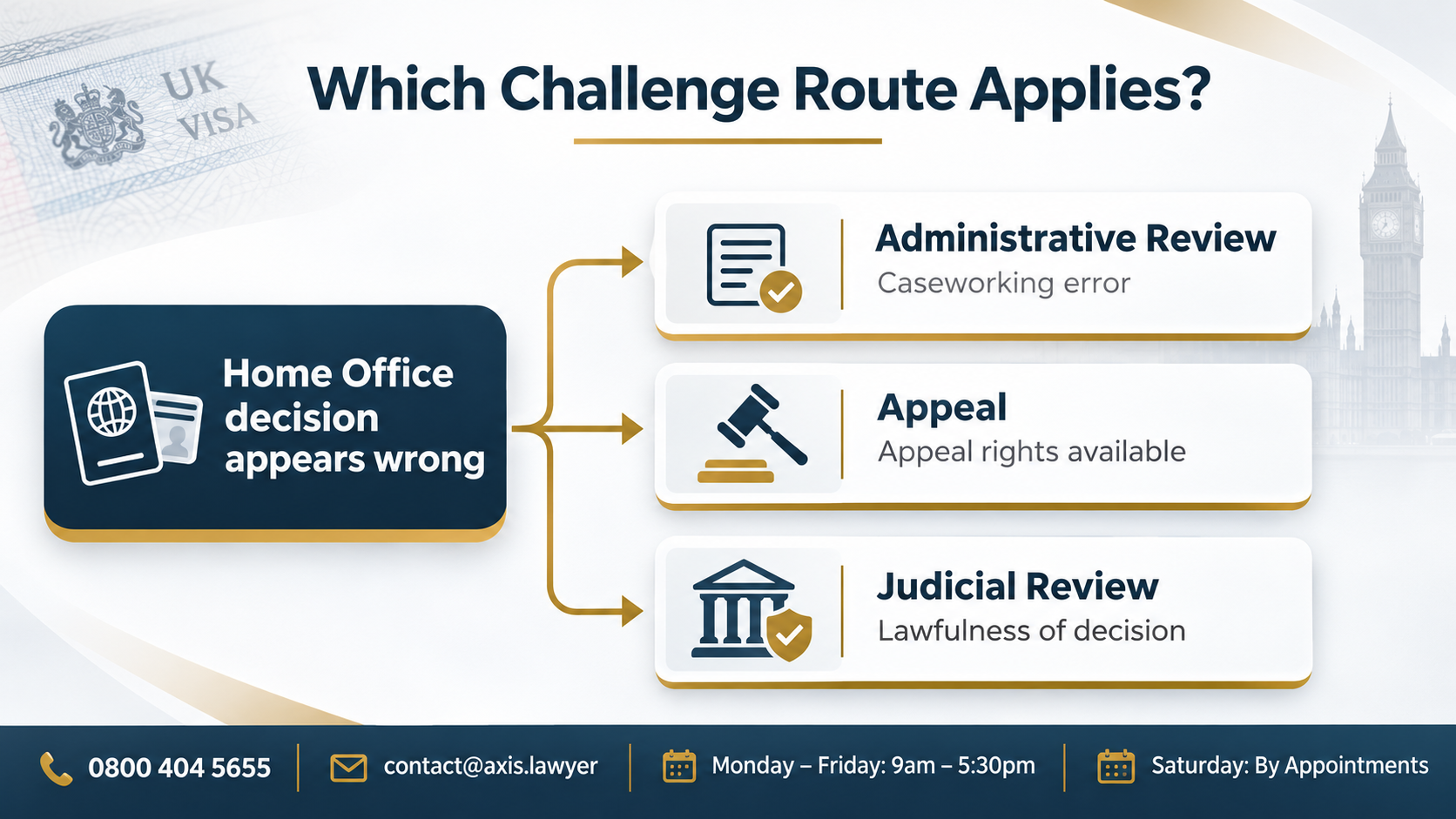
You can challenge a Home Office decision by administrative review, an appeal to the First-tier Tribunal, or judicial review. These routes are often used after a visa refusal or for in-country decisions on UK visas, and your decision letter should say which applies.
|
Route |
What it examines |
Who decides |
Usual deadline |
|---|---|---|---|
|
Administrative review |
Whether a case working error was made |
A different Home Office decision maker |
14 or 28 calendar days |
|
Appeal |
The decision on its merits, including new evidence |
An independent judge at the First-tier Tribunal |
Stated in your decision notice |
|
Judicial review |
Whether the decision was lawful, rational and fair |
The Upper Tribunal or High Court |
Promptly, and within 3 months |
The appeal route goes to the First-tier Tribunal (Immigration and Asylum Chamber). For a wider overview of your options, see our guide on how to appeal a Home Office decision and understand your rights.
How Does Administrative Review Work for a Home Office Decision Error?
Administrative review is part of the application process for challenging an eligible Home Office caseworking error, and it is decided by a different reviewer who checks whether the original decision contains a correctable error. It is usually the first step where you have no right of appeal. Administrative review costs £80 and is non-refundable unless successful.
The Home Office’s own guidance states that the time limit is 14 calendar days for in-country refusals and 28 calendar days for entry clearance refusals. If you are in immigration detention, the in-country limit is 7 calendar days.
What Can You Raise in an Administrative Review?
You can only raise the specific errors the rules allow, such as a wrong factual finding or a misapplied requirement. You generally cannot add new evidence, apart from limited exceptions, so your original submission matters.
What Happens to Your Immigration Status While You Wait?
If your permission was extended by section 3C (a rule that continues your leave while an application is pending), you applied in time, and the requirements are met, you can normally remain in the UK lawfully until the review is decided. A late request is normally rejected unless it would be unjust not to accept it.
What Are the Possible Outcomes?
-
Withdrawn: the error is accepted and the original decision is withdrawn or corrected, often with a grant.
-
Maintained: no error is found, so the original decision stands.
-
Modified: the refusal is upheld for different reasons, which may allow a second review.
The government reported 1,473 granted-in-error notifications affecting EUSS status grants by June 2026.
Only one application per decision is normally permitted, which is why preparing it carefully matters.
For the official guidance, see 3C and 3D leave (accessible).
When Can You Appeal to the First-tier Tribunal?
You can appeal where your decision letter gives you appeal rights, which usually arise where a human rights claim, a protection claim or an EU Settlement Scheme decision has been refused. Your decision notice will state the appeal deadline and how to lodge it.
An appeal is heard by an independent judge at the Immigration and Asylum Chamber of the First-tier Tribunal. Unlike administrative review, new evidence can usually be considered.
Can You Appeal an EU Settlement Scheme Error?
Yes, in many cases. People who hold pre-settled status or settled status under the EU Settlement Scheme, including EU citizens and a family member relying on the withdrawal agreement, may have appeal rights if the Home Office refuses, curtails or wrongly grants their status.
If a grant of pre-settled status gives you less than you were entitled to, that may be an incorrect grant that can be challenged. The Independent Monitoring Authority oversees how citizens’ rights under the withdrawal agreement are protected, and may be a useful point of contact for some EUSS status holders. It has also criticized the Home Office policy on EUSS grants made in error. Judicial review proceedings challenging that policy were filed on 6 November 2026.
What If You Lose the Appeal?
You may be able to ask for permission to appeal to the Upper Tribunal, but only on a point of law (a legal error in how the judge decided the case). Deadlines at this stage are short, so seek legal advice as soon as you receive the outcome.
Our guide on immigration appeal strategy and evidence explains how cases are prepared for hearing.
When Is Judicial Review the Right Challenge?
Judicial review is a court process that tests whether a decision was lawful, rational and fair. It is normally a last resort, used where there is no right of appeal or administrative review, or where those routes have been used. It may also be used to challenge an unlawful Home Office error policy where no adequate appeal route exists.
The official guidance explains that you must send the application so the Upper Tribunal receives it no later than 3 months after the decision. The claim must also be made promptly, so waiting until the last day can be risky.
Where Is an Immigration Judicial Review Heard?
Most claims go to the Upper Tribunal (Immigration and Asylum Chamber). Some matters, such as challenges to detention or a British citizen naturalisation refusal, usually go to the High Court’s Administrative Court instead.
What Does Judicial Review Achieve?
A successful claim usually results in the decision being quashed (cancelled) and sent back to be made again. The court does not normally grant your visa itself, and no outcome is guaranteed.
Do You Need to Write to the Home Office First?
Usually, yes. A pre-action letter is usually the first step in legal action, setting out your grounds and asking the Home Office to reconsider before you apply for judicial review if the issue is not resolved, and the Home Office normally replies within 14 days. The letter does not extend the 3 months, so it should be sent early.
If the Home Office error has led to detention or removal action, urgent steps may be needed. Our team also advises on immigration bail in those situations.
What Evidence Helps If the Home Office Has Made a Mistake?
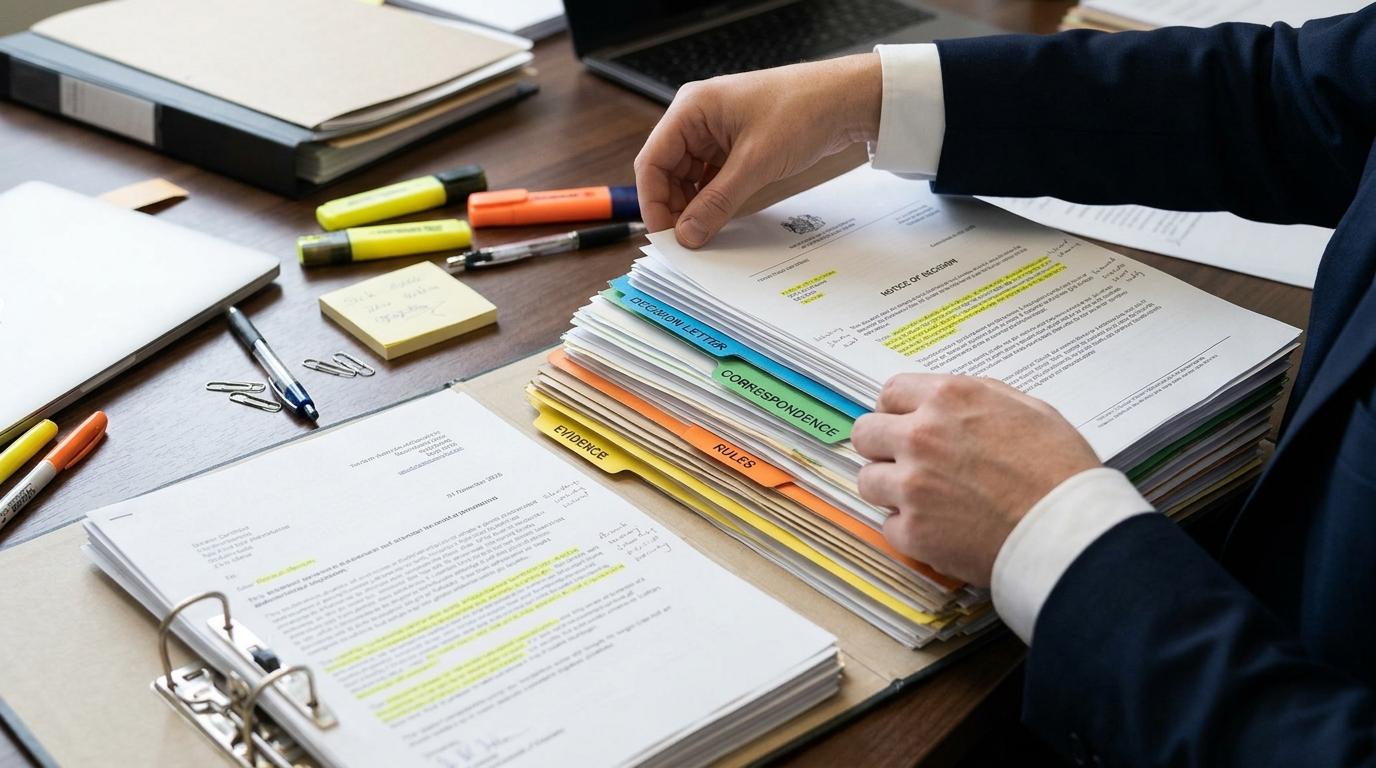
Clear, organised evidence of what you submitted and when is the strongest support for any challenge. It lets a reviewer or judge see exactly where the decision went wrong. For example, where nationality by descent is in issue, relevant evidence may include proof of nationality and records showing when Italian citizenship legally took effect if the Home Office accepted that such evidence establishes citizenship from birth.
-
Submission proof: upload confirmations, courier receipts and emails showing what was sent.
-
Relevant evidence: the specific documents the refusal letter says were missing or insufficient.
-
The decision itself: the full refusal decision and any attached notices.
-
Rule references: the paragraphs of the immigration rules or guidance you say were misapplied.
Keep copies of everything. If you need to rely on new evidence, an appeal or a fresh immigration application may be more suitable than administrative review.
What Should You Do Straight Away?
-
Record the date you received the decision and calculate your deadline.
-
Do not make a new application until you have taken advice, as this can affect a pending review.
-
Gather your decision letter and supporting documents.
-
Seek legal advice from an immigration lawyer before choosing a route.
Sometimes a fresh application is quicker than a challenge, particularly where the refusal was for missing documents. A solicitor can compare the options against your circumstances, including long residence settlement cases where the evidence rules are detailed.
How Our Immigration Team Can Help You Correct a Wrongful Home Office Decision
Axis Solicitors is authorised and regulated by the Solicitors Regulation Authority (SRA No. 653526), with offices in Manchester, Birmingham and London. Our team can review your refusal, identify any error and advise on the right route.
-
Immigration Appeals: we assess whether you have appeal rights or can seek administrative review, and prepare the grounds and evidence for a challenge before your deadline.
-
UK Immigration: where a fresh application is the better option, we help you prepare it with the evidence the decision maker needs to see.
Frequently Asked Questions
Can I challenge a Home Office decision if I think it is wrong?
Yes, if a route is available to you. Depending on the decision, that may be administrative review, an appeal or judicial review, and your decision letter should say which applies.
How long do I have to apply for administrative review?
Usually 14 calendar days for a refusal made inside the UK and 28 calendar days for an entry clearance refusal. If you are detained, the in-country limit is 7 calendar days.
Can I submit new evidence in an administrative review?
Generally no. Administrative review looks at whether the caseworker made an error on the evidence already provided, with only limited exceptions.
Is judicial review the same as an appeal?
No. An appeal can look again at the merits of your case, whereas judicial review only asks whether the decision was lawful, rational and procedurally fair.
What is the time limit for judicial review of an immigration decision?
The claim must be made promptly and the Upper Tribunal must receive it within 3 months of the decision. Shorter limits can apply in some cases, such as challenges to First-tier Tribunal decisions.
Will the Home Office correct its own mistake without a formal challenge?
Sometimes. A well-evidenced pre-action letter or review request can lead the Home Office to withdraw a decision, but this is never guaranteed.
Speak to a Solicitor About Your Home Office Decision
If your decision letter contains an error, the next step is to confirm which challenge route you have and act before the deadline. Our Immigration Appeals team can review your refusal, advise on administrative review, appeal or judicial review, and prepare your case. Our UK Immigration team can help if a fresh application is the quicker option.
Contact Axis Solicitors through our contact page to speak to a solicitor about your options.