

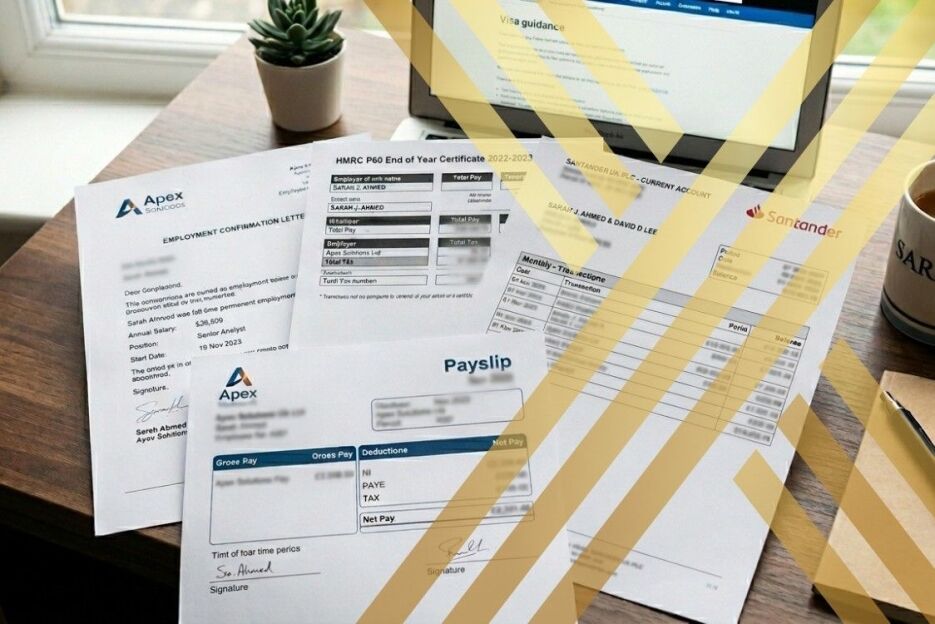
Receiving a spouse visa refused payslips decision can feel overwhelming, but understanding exactly what went wrong is the first step toward bringing your family together in the UK. The financial requirement rules under Appendix FM-SE are strict, and even minor errors in payslip evidence can lead to refusal. This guide explains when three months of payslips are acceptable, what supporting documents you need, and how to fix a refusal caused by payslip issues.
Many applicants face a spouse visa refused payslips outcome each year, often due to technical errors rather than insufficient income. Here are the essential points you need to know: From 11 April 2025, the minimum income threshold for a UK spouse visa is £29,000 gross per year. The most common reason for UK spouse visa refusals is failing to meet this financial requirement.
Sponsors can use three months of payslips to meet the financial requirement only if they have been employed for less than six months and meet both the Gross Annual Salary Test and the 12-Month Income Test under Category B.
Most sponsors still need six months of payslips and matching bank statements under Category A rules. Missing even one month of payslips will cause an automatic refusal if your sponsor has been with their employer for six months or longer. Common mistakes that lead to spouse visa refusals include mismatched payslip and bank statement amounts, missing details on the employer letter, and incorrect calculations of the 12-month income period.
Axis Solicitors can review your spouse visa refused payslips, advise on administrative review or appeal options, and help prepare a fresh, compliant spouse visa application.
Why Spouse Visa Applications Get Refused Because of Payslips
If your application has been refused due to spouse visa refused payslips, you are not alone. Many spouse visa refusals occur because the Home Office expects applicants to follow strict evidential rules set out in the immigration rules, specifically Appendix FM-SE.
Even when a settled partner earns well above the £29,000 threshold, UKVI caseworkers will refuse the visa if the payslips fail to comply with the meticulous formatting and timeline rules set out in the immigration guidance. In the UK spouse visa application process, payslips are the primary evidence used by UK Visas and Immigration (UKVI) to verify that your sponsor meets the strict minimum income requirement.
Typical spouse visa refused payslips reasons include:
- Using the wrong income category (applying Category A rules when Category B applies)
- Providing insufficient months of payslips
- Mismatched amounts between payslips and salary deposits shown in bank statements
- Missing or incomplete employer letters
- Documents older than 28 days at the time of application form submission
Caseworkers follow Appendix FM and Appendix FM-SE strictly and have limited discretion when financial evidence is incomplete or inconsistent. Insufficient relationship evidence like spouse visa refused payslips is a common reason for UK spouse visa refusals, as the UKVI must be satisfied that the relationship is genuine and not a marriage of convenience. However, the financial requirement remains the primary hurdle.
Applications can be refused due to insufficient evidence of a genuine relationship, which must be proven to be real and ongoing. Inconsistencies between the required information provided by the applicant and their UK-based partner can lead to visa refusals, as the Home Office assesses the overall credibility of the relationship based on all supporting documents, communication history, and personal circumstances.
Understanding the Financial Requirement and Income Categories
Getting the income category right is crucial to avoid a spouse visa refused payslips decision. The financial evidence provided in a spouse visa application must match the strict requirements of Appendix FM-SE.
From 11 April 2025, the minimum income threshold is £29,000 gross per year for couples without dependent children, as part of the updated financial requirements for UK spouse visa. Additional income is needed for each child included in the application.
Income Categories Under Appendix FM-SE
The UK immigration rules define several income categories for proving the financial requirement and avoiding spouse visa refused payslips.
| Category | Description | Payslip Requirement |
| Category A | Same employer for 6+ months with stable employment income | 6 months of payslips |
| Category B | Current employer for less than 6 months, or variable income | 3 months of payslips (if tests met) |
| Category C | Non employment income (rental income, dividends) | 12 months of evidence |
| Category D | Cash savings | 6 months of bank statements |
| Category E | Pension income | 12 months of evidence |
| Category F/G | Self employment or company director income | Full business accounts |
If the income requirement cannot be met through employment alone, other sources such as pension income, non-employment income, or savings may be used, provided they meet the format and duration criteria under Appendix FM-SE.
One common pattern in spouse visa refused payslips refusals is mis-labelling a case as Category A when Category B actually applies. If your sponsor started a new job recently, they cannot rely on six months of payslips from the same company and must instead meet the Category B tests.
When Can You Use Only 3 Months’ Payslips? The Category B 3-Month Rule
The 3-month payslip rule applies only in specific Category B situations, not to all spousal visa applications. Understanding these rules can prevent spouse visa refused payslips and your application refusal.
The Two Category B Tests
To rely on three months of payslips, your sponsor must pass both income tests:
- Gross annual salary test: The current salary with the current employer must be at least £29,000 at the date of application
- 12-Month Income Test: Total income from current employment and previous employment over the 12 months before application must also be at least £29,000
Worked Example: Passing Both Tests
Sarah’s UK based partner, James, started a new job in January 2026 earning £31,000 per year. Before this, he earned £25,000 at his previous employer during 2025.
- Current gross annual salary: £31,000 (passes first test)
- Past 12 months’ total income: £31,000 × 3/12 + £25,000 × 9/12 = £7,750 + £18,750 = £26,500
This example actually fails the second test because the annual income over 12 months is below £29,000. James would need past earnings from his previous employment to be higher, or they would need to supplement with cash savings.
Worked Example: Meeting Both Tests
Consider a different scenario where the sponsor earned £28,000 in the previous job and has three months at the new £32,000 role:
- Current salary: £32,000 (passes)
- 12-month calculation: £32,000 × 3/12 + £28,000 × 9/12 = £8,000 + £21,000 = £29,000 (passes)
In this case, three months of payslips would be acceptable, provided all supporting documents are correct.
If either test is not met, the application should not rely solely on the 3-month payslip rule. To replace income completely with savings, applicants must hold at least £88,500 in savings, calculated using the Home Office formula as £16,000 plus 2.5 times the £29,000 shortfall.
Evidence Needed: Payslips, Bank Statements and Employer Letter

Most spouse visa refused payslips decisions arise from missing or defective supporting documents, not just low income level. The Home Office expects comprehensive documentation regardless of which category applies.
Category B Requirements
Under Category B, sponsors must provide:
- Three consecutive monthly payslips from the current employer
- Three corresponding bank statements showing salary deposits that match the payslip amounts
- An employer letter on official headed paper confirming job title, start date, contract type (permanent, fixed-term, or agency), and gross annual salary
Category A Requirements
Under Category A, the Home Office normally expects:
- You must provide exactly 6 months of consecutive payslips leading up to the application date
- Six months of matching bank statements showing salary credits into the sponsor’s bank account
- A comprehensive employer letter with all job details
Three months of payslips are not acceptable for Category A applicants and will cause spouse visa refused payslips.
The 28-Day Rule
To avoid refusals, all financial documents must be dated within 28 days of the application submission date; outdated documents will be considered invalid. This applies to payslips, bank statements, and employer letters alike.
Electronic and Digital Documents
Digital or electronic payslips downloaded from an online portal must be completely authentic, which may require them to be on official corporate letterhead or confirmed by an employer’s letter. Online bank statements should be stamped by the bank or accompanied by a letter from the regulated financial institution confirming their authenticity.
Payslips cannot be submitted alone; they must be accompanied by an official employer letter confirming employment details, alongside matching bank statements, otherwise you’ll have to face spouse visa refused payslips.
Common Payslip Mistakes That Lead to Refusal
A spouse visa refused payslips decision is often triggered by small, avoidable technical errors in financial evidence. A thorough and correctly formatted application is the best protection against refusal; this includes ensuring all documents are clear, complete, and consistent throughout the application.
Payslip and Bank Statement Issues
Common document errors that lead to spouse visa refused payslips include:
- Mismatched amounts between net pay on payslips and deposits on bank statements
- Gaps in dates or missing months within the same consecutive period
- Documents from previous employment not clearly separated from current employment records
- Using net income instead of gross when calculating against the £29,000 threshold
- Submitting incomplete or incorrectly formatted application forms
If your sponsor is on a fixed salary but received a lower amount in one month, the Home Office calculates annual income by taking the lowest month’s pay multiplied by 12, and this must meet the minimum income threshold of £29,000. The Home Office uses the lowest payslip in the six-month period to calculate salaried income under Category A, which can cause you to fall short unexpectedly.
Employer Letter Problems
An employer letter accompanying payslips must explicitly state:
- The sponsor’s job title and employment type
- Their exact gross annual salary
- Details of their employment duration and current salary level
- Confirmation that payslips are genuine
Letters missing a signature from an authorised person in HR or management, or those not on official letterhead, frequently result spouse visa refused payslips.
Cash Savings Errors
When using cash savings to supplement income shortfalls, common mistakes include:
- Savings held for less than six months before application
- Failing to provide evidence of the savings source
- Incorrect calculations using the Home Office formula
Failure to provide adequate accommodation evidence can also result in spouse visa refused payslips and ultimately spouse visa refusal, as the Home Office must be satisfied that the living arrangements are suitable for the family.
How to Fix a Spouse Visa Refused Because of Payslips
A spouse visa refused payslips decision like any other spouse visa refusal can usually be corrected through appeal, administrative review (where available), or a fresh application. If your application was refused due to payslip errors, you should thoroughly analyse the refusal letter, as this will outline exactly which of the strict Appendix FM financial requirements you failed to meet.
Steps to Prepare a Fresh Application
- Read the refusal letter carefully, noting the specific paragraphs of Appendix FM-SE cited
- Recalculate income correctly to confirm which category applies
- Obtain complete runs of payslips covering the required same period
- Request a new employer letter with all required details
- Gather matching bank statements for the same consecutive period
- Consider adding cash savings where there is an income shortfall
- Prepare a covering letter explaining how each refusal point has been addressed
There is no cooling-off period required before reapplying for a visa; you can submit your application as soon as you hold the correct documents. If the spouse visa refused payslips were caused by a clear omission, submitting a fresh application is usually the fastest route.
You must disclose your visa refusal in your new application form, as concealing it can lead to a 10-year ban for deception. This disclosure will not automatically harm future immigration applications if you demonstrate the original issues have been resolved.
Keep all future financial documents organised month by month, ready for submission within the 28-day validity window.
Appeal, Administrative Review and Tribunal Options
Some spouse visa refused payslips cases can be challenged through the appeal process or administrative review, depending on the decision type and location of the applicant.
Administrative Review
You can request an administrative review of your spouse visa refusal, which is an internal review by the Home Office to check for errors in the initial decision. This is typically available for certain points-based decisions but may have limited application to family visa refusals.
Appeal to the First-tier Tribunal
If your spouse visa application is refused due to spouse visa refused payslips, you can appeal the decision to the First-tier Tribunal (Immigration and Asylum Chamber) if the refusal letter confirms your eligibility to do so. Most spouse visa refusals carry a right of appeal based on human rights (Article 8) grounds. Key points about the appeal process:
- After receiving a refusal letter, you must submit your appeal to the First-tier Tribunal within 14 days if you are in the UK, or 28 days if you are outside the UK
- If you choose to appeal, the process can take 6 to 12 months before a decision is made
- Tribunals often consider updated payslips, bank statements, cash savings, and a more detailed employer letter to remedy earlier evidential failings
- You can submit a comprehensive appeal bundle with corrected financial evidence
If your appeal is unsuccessful, you may have the option to request a judicial review if you believe the decision was flawed in its procedure.
Choosing Between Appeal and Fresh Application
Before deciding, couples should weigh timescales, costs, and prospects of success. An experienced UK immigration lawyer can provide tailored advice on the best route forward after facing spouse visa refused payslips.
How Axis Solicitors Can Help with Spouse Visa Refusals
Axis Solicitors is a UK immigration law firm with offices in Manchester, London, and Birmingham, experienced in resolving spouse visa refused payslips cases.
Key Services
- Refusal letter review and detailed analysis
- Income and financial requirement assessment across all income categories and income sources
- Document checklist creation covering payslips, bank statements, employer letters, and cash savings
- Preparation of fresh applications or appeal bundles
- Direct liaison with your current employer to ensure the employer letter contains all details required by Appendix FM-SE
Our team can assist with cases involving variable income, self employment, rental income, company director income, or complex arrangements involving multiple income sources.
Axis Solicitors offers remote consultations by phone and video, making it easy for applicants in the UK or abroad to get quick advice after spouse visa refused payslips decision. Whether you need help understanding why your spousal visa application failed or guidance on preparing stronger supporting documents, expert assistance can make the difference.
Request a Consultation with an immigration solicitor to discuss your spouse visa refused payslips decision and your next steps.
FAQs about Spouse Visa Refused Payslips
Can I rely on three months’ payslips if my spouse visa was refused the first time?
Three months’ payslips are only acceptable under Category B if both the current salary test and 12-month income test are met, and all documents (payslips, bank statements, employer letter) comply with Appendix FM-SE. If your previous spouse visa refused payslips decision arose because Category A rules were wrongly applied or evidence was incomplete, a new application can succeed with the correct category and full documentation. Each case depends on employment history and whether both income tests are satisfied.
Can cash savings fix a spouse visa refused due to low income on payslips?
Cash savings under Category D can be used to meet the financial requirement where there is an income shortfall, using the Home Office formula (shortfall × 2.5 + £16,000). The savings must usually be held for at least six months in an account with a regulated financial institution, under the control of the applicant, sponsor, or both. Correct evidence of this, including bank statements covering the full period and proof of source, can help overcome a previous spouse visa refused payslips outcome.
Do I need a new employer letter after a spouse visa refused payslips decision?
A fresh, fully compliant employer letter is strongly recommended for any reapplication or appeal, especially where the refusal letter criticised missing or vague employment details. The letter should cover: job title, start date, type of contract (permanent or fixed-term), gross annual salary, normal working hours, and confirmation that payslips are genuine and accurately reflect pay. An employer letter dated within 28 days of your new application is essential.
How long after a refusal can I reapply for a UK spouse visa?
There is no mandatory waiting period to reapply after a spouse visa refused payslips decision. However, a rushed reapplication without fixing the underlying evidence is risky and may result in another refusal. Applicants should only submit a new application once the correct number of payslips and bank statements, updated employer letter, and any required cash savings evidence are ready and within the 28-day document window.

