

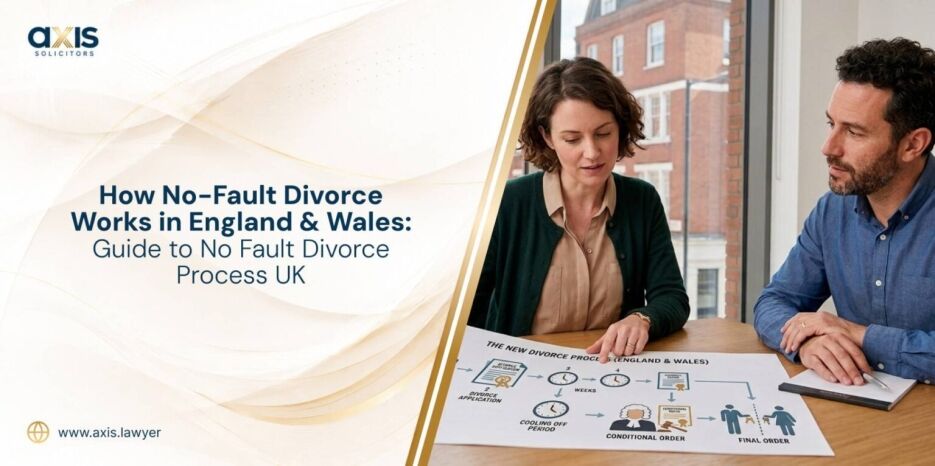
Ending a marriage is rarely simple, but the legal process no longer has to add fuel to the fire. Since the Divorce, Dissolution and Separation Act came into force, couples in England and Wales can manage the no fault divorce process UK without pointing fingers or proving wrongdoing.
There is now only one ground for divorce in England and Wales: a statement that the marriage has irretrievably broken down. You do not need to prove fault, unreasonable behaviour, adultery, or separation.
The minimum time for a no-fault divorce is 26 weeks from the date the court issues the application to the earliest date for a Final Order. That includes a mandatory 20-week reflection period plus at least 6 weeks and 1 day after the Conditional Order.
At Axis Solicitors, our experienced family law team manages the divorce proceedings with legal expertise and compassionate support. Whether you are thinking about separation or have already made the decision, this guide explains the no fault divorce process UK and important considerations.
No-Fault Divorce Process UK at a Glance (Visual Overview)
Before we walk through the detail, here is a quick snapshot of the UK no fault divorce process and its core features.
No-Fault Divorce: The Essentials
- Law: Divorce, Dissolution and Separation Act 2020 (in force 6 April 2022)
- Ground: Irretrievable breakdown, stated by one or both spouses
- Applicants: Sole applicant or joint applicants
- Portal: Her Majesty’s Courts and Tribunals Service (HMCTS) online portal (or by post)
- Court fee: £628
- Legal fees: Vary depending on complexity and whether you instruct a solicitor
- Cannot be blocked: Your spouse cannot contest the divorce simply because they disagree
Mandatory stages at a glance:
- Application issued by the Family Court (England and Wales)
- 20-week reflection period begins
- Conditional Order applied for and granted
- Further 6 weeks and 1 day minimum waiting period
- Final Order applied for and granted (marriage legally ends)
What Is the No-Fault Divorce Law in England and Wales?
The no-fault divorce system was implemented in England and Wales on 6 April 2022. It replaced the old law where a spouse had to prove one of five facts, such as adultery, unreasonable behaviour, desertion, or two or five years of separation, to demonstrate that the marriage had broken down.
The traditional divorce required proof of one of five facts for a marriage to be deemed irretrievably broken, and this often forced couples into a blame divorce even when both wanted to part ways amicably.
Under the Divorce, Dissolution and Separation Act 2020 the only ground is irretrievable breakdown. An applicant simply provides a statement confirming that the marriage has broken down irretrievably.
The UK court treats that statement as conclusive evidence, which is why the ability to defend a divorce is now restricted to narrow issues such as jurisdiction or the validity of the marriage. No fault divorce reduces conflict by eliminating blame from the legal process, though some critics note that it may lack accountability for relationship breakdown.
Who Is Eligible for a No-Fault Divorce in England and Wales?
Anyone who meets the standard eligibility criteria can use the no fault divorce process, regardless of nationality. The rules apply equally to opposite-sex and same-sex marriages, and the same framework covers civil partnership dissolution where relevant.
Core eligibility requirements to start divorce proceedings
- The marriage is legally recognised under UK divorce law.
- You must have been married for at least one year before you can apply for a divorce.
- The Family Court in England and Wales must have jurisdiction, which is based on habitual residence or domicile of one or both parties.
Jurisdiction can be established in several ways. For example, if both spouses are habitually resident in England and Wales, or if the applicant has been habitually resident here for at least one year before applying, the English and Welsh courts will have power to deal with the case.
If your spouse lives abroad or you have international ties, early legal advice is important because the rules can be complex.
Sole vs Joint Applications: Choosing the Right Route
The no fault divorce process UK gives you two options: a sole application filed by one party, or a joint divorce application UK filed by both spouses together. The choice affects who controls the process, how papers are served, and how cooperative the overall experience is likely to be.
- Joint applications often suit amicable separations where both partners agree the marriage is over.
- A sole application may be the better route where communication has broken down, one spouse is uncooperative, or there are safety concerns linked to domestic abuse.
One helpful feature of the current rules is flexibility: you can start a joint application and convert to a sole application later if other party stops engaging. This means you are never trapped in a process that requires ongoing cooperation from someone who refuses to participate.
| Feature | Sole Application | Joint Application |
| Initiating party | One spouse (the sole applicant) | Both spouses together |
| Service of papers | Court serves on respondent | No formal service needed |
| Control over progress | Applicant drives the timetable | Shared control; requires cooperation |
| Risk of delay | Possible if respondent ignores papers | Lower, but stalls if one party disengages |
| Ability to switch routes | N/A | Can convert to sole if needed |
| Recommended when | Communication has broken down or domestic abuse | Amicable separation with mutual agreement |
The Step-by-Step No-Fault Divorce Process in the UK

This section walks through the no-fault divorce process UK from application to Final Order, following the Family Court procedure in England and Wales.
Step 1: Submitting the Application
You prepare and submit the application through the HMCTS online portal (or by post). You need an original or certified copy of your marriage certificate to accompany the application. You can apply for divorce online or by post. The current court fee is £628, though applicants on certain benefits or low incomes can apply for Help with Fees (form EX160) to reduce or waive this.
Step 2: Service and Acknowledgement of Service
For sole applications, the court issues the application and serves it on the respondent, who has 14 days to acknowledge service. Delays can occur if documents are not served correctly, for example if your spouse is overseas or cannot be traced. In a joint application, service is handled internally between the two applicants.
Step 3: The Mandatory 20-Week Reflection Period
There is a mandatory 20-week reflection period before applying for the Conditional Order. This clock starts from the date the court issues the application, not from the date you submitted it. During this time, couples are encouraged to reflect, attend counselling if appropriate, and begin financial negotiations or discuss child arrangements.
Step 4: Applying for the Conditional Order
You must wait 20 weeks before applying for a Conditional Order. Once the period has passed, you (or both of you in a joint application) confirm you still wish to proceed. The court checks jurisdiction, validity of the marriage, and that all formalities are in order. If satisfied, the Conditional Order is granted. A Conditional Order confirms the divorce can proceed but does not end the marriage.
Step 5: The 6-Week and 1-Day Waiting Period
You must wait 6 weeks and 1 day after the Conditional Order before you can apply for the Final Order. This period gives time to finalise financial matters, secure a consent order, and ensure linked proceedings are on track.
Step 6: Applying for the Final Order
The Final Order is the legal document that dissolves the marriage. Once granted, the divorce legally ends the marriage, allowing the parties to remarry or enter a new civil partnership if they wish. You are now legally divorced.
Costs and Court Fees for No-Fault Divorce in the UK
The divorce application fee is £628 in the UK. This is the standard court fee set by the government for issuing a divorce or dissolution application in England and Wales and applies whether you file as a sole applicant or jointly.
The total no fault divorce cost will include the court fee plus any fixed-fee or hourly-rate legal costs for advice on the divorce, finances, and children. If you need a contested financial order, the court fee for a Form A application is an additional £321. A consent order, where finances are agreed, costs around £60.
No-fault divorce can be less expensive than traditional divorce because there is no need for lengthy evidence-gathering on behaviour or separation, and the process is more predictable.
Key Statutory Milestones Explained
Here are three mandatory stages in every standard no fault divorce UK process. These milestones are set by statute and apply regardless of who initiated the separation or who was “to blame” under the old fault divorce law.
The Mandatory 20-Week Reflection Period
From the date the court issues the application, there is a minimum 20-week reflection period divorce before you can request a Conditional Order. Parliament introduced this pause to allow couples time to confirm their decision, seek counselling if appropriate, and negotiate financial settlement and child arrangements.
You remain legally married during this period. Financial negotiations can begin during the 20-week reflection period, and expert divorce solicitors recommend using this window to progress discussions on property, pensions, and income.
The Conditional Order (Formerly the Decree Nisi)
The Conditional Order is the court’s confirmation that you meet the legal requirements for divorce and that it sees no reason to refuse it. It does not end the marriage; you are still legally married at this stage.
Many financial consent orders are only approved by the court after the Conditional Order has been made, making timing important. For people familiar with older terminology, this stage replaced the decree nisi, and both terms may appear in older guidance or case law.
The Final Order (Formerly Decree Absolute)
You can apply for the Final Order at least 6 weeks and 1 day after the Conditional Order, assuming no other issues are outstanding. The Final Order legally ends the marriage and restores each person’s legal status to single, allowing them to remarry if they wish.
Applying for the Final Order before resolving financial claims can have serious practical consequences for pensions, inheritance, and death-in-service benefits. Without a binding financial order in place, a former spouse may still bring future claims.
Where a respondent does not apply for the Final Order, the applicant may be able to do so later, subject to extra safeguards. This is where tailored legal advice is vital.
Finances, Property and Pensions: Separate but Crucial

The no fault divorce process UK only ends the legal relationship. It does not automatically divide assets, pensions, or income. Divorce does not automatically resolve financial matters, and this is one of the most important points to understand early.
A financial consent order is a court-approved agreement setting out how assets, debts, and income will be divided. It is the only way to make a financial settlement legally binding and enforceable. Financial settlements must be approved by the court to have legal force.
Without a court-approved financial order, either spouse may bring financial claims years after the Final Order, even if remarried. The family home, pensions, savings, and business interests all need to be considered. Specialist advice is often needed where there are complex assets or international elements.
We recommend that financial negotiations run in parallel with the divorce proceedings. For details, see our divorce financial settlement guide. Financial matters are handled in separate but related proceedings, and getting the right advice on your financial position can make a significant difference to the outcome.
Children and Parenting Arrangements During Divorce
No fault divorce law focuses on ending the legal status of the marriage. Child arrangements are dealt with entirely separately under the Children Act 1989. No-fault divorce does not impact financial settlements or arrangements for children, which are handled separately.
Typical issues to resolve include where the children will live, how much time they spend with each parent, schooling, holidays, and communication with wider family. Parents are encouraged to agree practical arrangements themselves or through mediation. Court orders such as a child arrangements order are usually a last resort.
The court’s primary test is the child’s welfare, not parental preferences. Any history of domestic abuse or safeguarding concerns will be highly relevant to how the court decides. For more detail on parenting orders and court applications, see our child arrangement order guidance.
Special Considerations: Domestic Abuse, Safety and Vulnerability
For some people, starting the no fault divorce process UK is about leaving a relationship involving domestic abuse or coercive control. We understand how difficult and frightening that step can be, and the current system offers several features that can help.
No-fault divorce removes the need to detail years of behaviour in public documents. Instead, the legal process relies on a simple statement of irretrievable breakdown. Key safety features include the ability to keep your address confidential, exemptions from mediation in domestic abuse cases, and options for non-molestation or occupation orders where needed.
If you or someone you know is affected, the National Domestic Abuse Helpline (0808 2000 247) offers free, confidential support, independent of the legal process. We regularly assist domestic violence survivors to plan safe timings for service of papers and to coordinate the divorce with any parallel criminal or safeguarding proceedings.
How Axis Solicitors Supports You Through No-Fault Divorce
At Axis Solicitors, our family team has the depth of knowledge to guide you through every stage of no fault divorce process UK and protect your best interests.
How we can help:
- Advising on whether a sole or joint application is right for your situation
- Preparing and filing the application correctly via the HMCTS portal
- Managing service issues and dealing with jurisdiction questions
- Drafting and securing court-approved financial consent orders
- Handling child arrangements in parallel, including mediation referrals and court applications
- Strategic timing advice on when to apply for the Conditional Order or Final Order in light of pensions, inheritance, or business assets
Whether your divorce is straightforward or involves complex financial matters, instructing a family law solicitor early can save you time, money, and stress. Book a consultation with our family team to discuss your options and get clear, personalised advice on your divorce.
Infographic: Visual Guide to the No-Fault Divorce Process UK
The infographic below summarises the timeline and key decisions in the no-fault divorce process UK. It shows the journey from application to Final Order, with markers for financial and parenting steps along the way.
What the infographic covers:
- Application stage (sole vs joint applicants)
- 20-week reflection period (when to begin financial disclosure and negotiate finances)
- Conditional Order (when a financial consent order can become binding)
- 6 weeks and 1 day waiting period (final preparation before the marriage legally ends)
- Final Order (marriage dissolved, parties free to remarry)
- Colour-coded flags showing where legal, financial, and parenting advice is especially important
Frequently Asked Questions
Can my spouse stop or delay a no-fault divorce?
Under current divorce law, your spouse cannot stop a divorce simply because they disagree with it. They can only dispute on narrow grounds such as jurisdiction or validity of the marriage. If they ignore paperwork, the court has tools such as deemed service and bailiff service to move the case forward, though administrative delays can still occur.
Do we have to go to court in person for a no-fault divorce?
Most no fault divorce UK process cases are dealt with entirely on paper or online via the HMCTS portal, without any physical hearings. In unusual situations, such as disputes about service or complex jurisdictional issues, short hearings may be listed. A divorce lawyer can usually attend on your behalf.
What happens to our wills and inheritance after the Final Order?
Divorce usually cancels any gift to a former spouse in an existing will, but it is essential to make a new will once the Final Order is granted. Until the Final Order, your spouse may still inherit under an existing will or intestacy rules, so early estate-planning advice can be sensible.
Is counselling or mediation compulsory in a no-fault divorce?
Counselling is never mandatory but can help some couples process the emotional impact of relationship breakdown. Mediation is not compulsory for the divorce itself, but a Mediation Information and Assessment Meeting may be required before issuing separate court proceedings about finances or children, subject to exemptions such as domestic abuse.

