

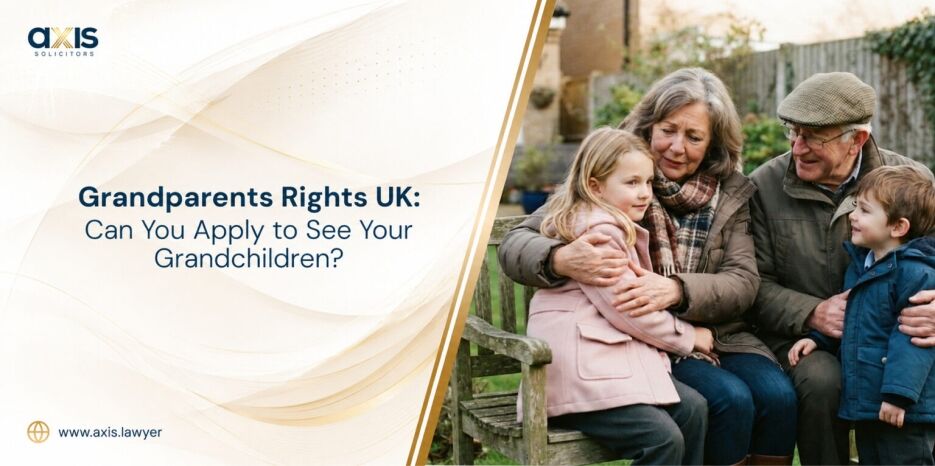
If you have been denied access to your grandchildren and are wondering about grandparents rights UK, you are not alone. Many grandparents got cut off from their grandchildren after a family breakdown.
In the UK, grandparents do not have an automatic legal right to see their grandchildren.
However, courts can and do grant contact when it is in the child’s best interests. Grandparents must usually seek the court’s permission before they can apply for a Child Arrangements Order to regain access to your grandchildren.
Mediation is often required before court applications, and many grandparents achieve regular contact through negotiated agreements or court orders. Options for grandparents seeking contact include informal arrangements and family mediation, as well as formal legal proceedings.
Axis Solicitors can guide you on child matters including mediation and court proceedings across England and Wales. Let us guide you on grandparents rights UK and available options for you.
Understanding Grandparents Rights UK Today
When family relationships break down, whether through divorce, separation, or personal conflict, the impact on extended family can be devastating. For many grandparents, the sudden loss of contact with their grandchildren is one of the most painful experiences they face.
Grandparents rights UK law does not grant automatic legal entitlements for adults to see children. Instead, UK law centres on the child’s welfare as the paramount consideration in every decision. That said, family courts in England and Wales do recognise the value of stable, loving grandparent relationships in a child’s life. In practice, around 58% of non-parent private law applications in England involve grandparents, showing just how common these cases are.
Whether you are exploring potential legal avenues or simply wondering do grandparents have rights, our family law team can help you navigate each step with clarity and compassion.
Do Grandparents Have Automatic Legal Rights?
The direct answer is no. Under current grandparents rights UK law, grandparents do not have an automatic legal right to see their grandchildren in England and Wales. Unlike parents, who usually hold parental responsibility through being named on the birth certificate or through a court order, grandparents have no automatic legal standing to make decisions about a child or to demand contact.
Because there is no automatic legal right, grandparents must apply to the court for permission (known as “leave”) before they can apply for a Child Arrangements Order. The court will look at each case individually, focusing on the child’s welfare and the applicant’s connection to the child rather than applying a blanket concept of grandparents legal rights.
Scotland uses different terminology and procedure, which we cover later in this article.
Can Parents Refuse Contact Between Grandparents and Grandchildren?
Yes. One or both parents with parental responsibility can initially decide whether grandparents have contact with their children. This means can parents stop grandparents seeing grandchildren informally? They can.
Common situations where parents may block contact include:
- Acrimonious divorce or separation
- New partners and shifting family dynamics
- Disagreements about parenting style
- Historic family disputes
However, grandparents cannot apply directly to the family court for a contact order if parents refuse access without first obtaining the court’s permission. Once a court order is in place granting contact with their grandchildren, parents object at their own risk, as they cannot override it. Breaching a court order can lead to enforcement action and even community service.
If parents refuse contact, grandparents can seek advice, explore family mediation, and ultimately apply to the court to ask for time with their grandchildren. The court will weigh the parents’ objections against the child’s best interests, safety, and the existing relationship with the grandparents.
How to Apply to See Your Grandchildren

This section provides a practical guide for grandparents asking “do I have grandparents rights?” and “how do I start the legal process?” when informal contact has broken down. The process to grandparents rights to see grandchildren is the same whether you are a grandfather or seeking specific grandmother rights. The law does not distinguish by gender.
Each stage should be documented carefully. Save texts, emails, letters, and records of missed contact, as this evidence can be important in later court proceedings.
Trying Communication Before Legal Action
Judges expect grandparents to try calm, respectful communication with the child’s parents before taking legal action, unless it is unsafe to do so. Practical options include:
- A written letter focused on the grandchildren’s needs
- A neutral third party, such as a trusted relative, acting as a go-between
- Short, child-focused emails that avoid blame
Avoid hostile social media posts or sharp exchanges. These can be shown to the court and used against you. Where there has been domestic abuse, intimidation, or serious safeguarding concerns, direct communication may not be appropriate. In those situations, seeking legal advice immediately is essential. Our guide to non-molestation orders may also be relevant.
Mediation Before Court (MIAM)
In England and Wales, a Mediation Information and Assessment Meeting (MIAM) is mandatory for grandparents before they can apply to the court. Mediation is required before applying to the court for contact in almost all cases.
At a MIAM, an independent family mediator explains the mediation process, assesses whether mediation is suitable, and may invite the parents to joint sessions. Mediation helps families reach agreements amicably and can improve communication between family members, sometimes avoiding court altogether.
Exceptions where a MIAM may not be required include:
- Recent domestic abuse with supporting evidence
- Urgent risk of harm to the child
- A previous MIAM within the last four months
If mediation fails, a certificate allows court application. The mediator will sign the relevant part of the C100 form so you can proceed.
Child Arrangements Orders and the Court’s Permission
A Child Arrangements Order, made under the Children Act 1989, can regulate where a child lives, when a child spends time with particular people, and how maintaining contact works. Grandparents can apply for a Child Arrangements Order for contact, but they normally need to get the court’s permission first.
Grandparents use Form C2 to request permission from the court. If granted, grandparents apply for a Child Arrangements Order using Form C100, filed with the family court along with the relevant fee or fee remission application.
Permission may not be required if the child lives with the grandparent for a continuous period of at least three years, or if all parties with parental responsibility consent.
What the Court Considers When Granting Permission
When deciding whether to grant permission for grandparents to apply, the judge will consider:
- The nature and strength of the existing relationship with the grandchild
- The applicant’s connection to the child’s daily life
- The potential impact on the child and wider family
- Any safeguarding or welfare concerns, such as past violence, substance misuse, or neglect
Safeguarding concerns can limit grandparent contact rights. However, this stage does not decide how much contact there will be, only whether the full application should proceed. Many caring grandparents pass this stage successfully. Courts consider the grandparent’s previous involvement with the child as a key factor.
We recommend preparing a short, clear statement explaining your history of involvement, typical time spent with the child, and why you believe contact will benefit the child’s well being.
What a Child Arrangements Order Can Include
A Child Arrangements Order can set out a wide range of contact arrangements:
| Type of Contact | Examples |
| Direct contact | Weekly face to face visits, overnight stays, holiday time |
| Indirect contact | Letters, video calls, phone calls, emails |
| Supervised contact | Sessions at a contact centre or with an agreed third party |
| Specific arrangements | Handovers at school, a neutral location, or a contact centre |
Orders can start with supervised or indirect contact and build up over time as trust and stability improve. If contact with their grandchildren is repeatedly blocked, grandparents can ask the court to enforce the order.
Court Proceedings: What to Expect
Once a C100 court application has been filed, the typical journey includes:
- Safeguarding checks by Cafcass
- First Hearing Dispute Resolution Appointment (FHDRA)
- Possible further directions hearings
- A contested hearing if no agreement is reached
Cafcass may speak with parents and sometimes with the child to prepare a report. Throughout court proceedings, the court prioritises the child’s welfare in contact decisions and uses the statutory welfare checklist to guide every outcome.
Many cases settle with agreed contact at an early stage, avoiding a full trial, especially where all parties involved receive clear professional advice. Axis Solicitors can represent you at each court hearing, prepare position statements, and handle negotiations on your behalf.
Court Costs and Timescales
How much does it cost to get grandparents’ rights through the courts? The fixed court fee for a C100 application is currently £263. Some grandparents may qualify for help with fees depending on income and benefits.
Additional legal costs depend on complexity. Solicitor preparation, representation at court hearings, and any expert reports all factor in. We aim to provide clear, upfront cost information at every stage.
Realistic timescales: straightforward cases can take around six to ten months from application to final order. Complex disputes or those involving safeguarding issues may take longer. Using mediation and negotiation effectively can reduce both you and the court’s time and cost.
Key Factors the Court Looks At in Grandparent Cases
The child’s welfare is the court’s paramount consideration under the Children Act 1989. The court prioritises the child’s best interests in contact cases, not the legal rights of adults.
Key welfare factors include:
- The child’s wishes and feelings, considered in light of the child’s age and understanding
- The child’s emotional, educational, and child’s physical needs
- Any risk of harm or domestic abuse
- The likely effect on the child of changing existing arrangements
- The strength and quality of the ongoing relationship between grandparent and grandchild
Courts are usually reluctant to cut off a positive, long-term relationship without strong evidence that continuation would cause harm. However, any history of conflict, allegations of undermining the child’s parents, or exposing the child to adult disputes will also be weighed carefully.
Grandparents’ Rights in England, Wales, and Scotland
Grandparents rights England and grandparents rights in Wales are broadly identical, as both use the Children Act 1989 and the same family court structure. Grandparents must seek permission to apply, attend a MIAM, and use the C100/C2 forms.
Grandparents rights Scotland differ in important ways. In Scotland, grandparents can apply to court for contact without needing permission if they claim an interest in the child, under the Children (Scotland) Act 1995 and the Children (Scotland) Act 2020. The child’s welfare remains central, but the procedural barrier is lower.
In Northern Ireland, grandparents access rights are different from that in England and Wales, though it shares many similarities with the English framework.
We advise grandparents to seek specific legal or professional advice based on where the child lives. Axis Solicitors can advise on England and Wales cases and help signpost support for cross-border family issues.
Special Circumstances: When Grandparents Seek Custody or Guardianship

In serious situations, such as parental addiction, imprisonment, long-term illness, or neglect, grandparents may look beyond contact to caring for the child full-time. There are clear reasons grandparents can file for custody of grandchild UK-wide.
The main legal routes include:
- A Child Arrangements Order stating the child lives with the grandparent
- A Special Guardianship Order, which grants long-term parental responsibility to grandparents if parents are unfit to care
In Q3 2023-24, 55% of Special Guardianship Orders were granted to grandparents. Around 121,000 children in England and Wales were living in kinship care, with 59% living with at least one grandparent.
Where local authorities are involved, grandparents may be assessed as kinship carers. These applications are more complex and require detailed evidence about the child’s psychological well being and the grandparent’s ability to provide safe, stable care. We can advise from the early stages if social services become involved.
Practical Tips for Strengthening Your Case
- Keep a clear record of your past involvement: dates of regular childcare, school runs, holidays, and important events in the child’s life
- Gather positive evidence such as photographs, cards, and messages that demonstrate a loving, stable relationship
- Focus all communications on the child’s needs and avoid criticism of the child’s parents, both in writing and in front of the child
- Seek expert legal advice early so that any court application is well-prepared, with relevant documents and witness statements
- Take a calm, child-centred approach. The court is more likely to support arrangements that minimise conflict and promote cooperation between family members
How Axis Solicitors Can Help Grandparents
We are specialist family law solicitors experienced in advising on grandparents rights UK issues, including contact, residence, prohibited steps orders, and Special Guardianship applications.
We offer:
- Free initial assessments, with remote appointments by phone or video calls
- In-person meetings at our offices in Manchester, London, and Birmingham
- Assistance with family mediation, drafting and filing court forms, preparing statements, and representing you at hearings
Our focus is on clear communication, realistic advice, and solutions that protect the grandchildren’s welfare while respecting the importance of family therapy and extended family connections.
Request a consultation today to discuss your situation and next steps with our family law team.
FAQs about Grandparents Rights UK
Can grandparents get legal aid to apply for contact?
In most private family law cases, including grandparents applying for a Child Arrangements Order, legal aid is limited. However, it may be available if there is evidence of domestic abuse or child protection concerns. We recommend checking current legal aid criteria and contacting Axis Solicitors to assess eligibility and discuss alternative funding options.
Does it make a difference if my name is on my grandchild’s birth certificate?
Only parents named on the birth certificate usually gain automatic parental responsibility. Grandparents do not gain extra legal rights through involvement at registration. However, evidence that you were involved from birth can support your case by showing a strong, long-standing relationship with the child.
What if my grandchild’s parents were never married?
Whether parents were married or not does not change the basic position that grandparents do not have automatic legal rights to see their grandchildren. Questions about parental responsibility orders for unmarried fathers may affect who is joined to the proceedings, and we can advise on how this interacts with your application.
Do I need the child’s consent if they are a teenager?
The court pays increasing attention to a child’s wishes and feelings as they grow older. For teenagers, the court may be reluctant to impose contact they strongly reject. Where safe and appropriate, grandparents should try to maintain a positive image and indirect contact so the young person feels able to express any wish to spend time with them.
Can I apply if social services are already involved with my grandchild?
If the local authorities have issued care proceedings or are considering removing the child, grandparents can ask to be assessed as kinship carers or apply for a Child Arrangements or Special Guardianship Order. These cases move quickly with strict deadlines, so seeking legal advice urgently is essential to understand your legal options and time limits.

