

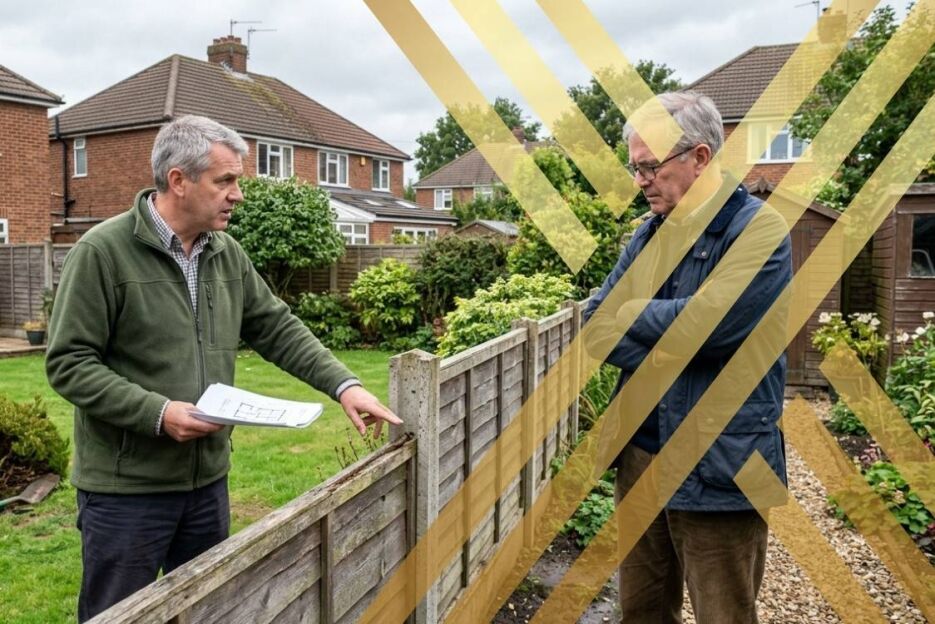
If you are dealing with a disagreement over a fence, wall, hedge or strip of land with a neighbour, you are not alone. Boundary disputes are among the most common property conflicts in England and Wales, and they can escalate quickly if left unaddressed. The good news is that with the right evidence, clear communication and proper legal guidance, most of these disagreements can be settled without ever stepping into a courtroom.
In England and Wales, a general boundary system is used. Property boundaries shown on HM Land Registry title plans are only general, not precise legal boundaries, so extra evidence such as historic conveyances and surveys is often needed. Most boundary disputes can be resolved without going to court by using open discussion, clear evidence and alternative dispute resolution such as mediation or expert determination.
Adverse possession and long use of land can sometimes move the legal boundary line, so specialist advice is important before taking action on disputed land. Axis Solicitors can provide practical legal help on boundary disputes for clients in Manchester, Birmingham, London and across England and Wales.
What Are Boundary Disputes Between Neighbours?
A boundary dispute arises when two neighbours disagree about where the exact boundary between their properties lies, who owns or is responsible for maintaining a boundary feature such as a fence or wall, or who has the right to use a small piece of land between two properties. These disagreements can affect freehold houses, leasehold flats with gardens, and commercial premises alike.
Typical examples include a new boundary fence being erected a few inches inside or outside the original line, an extension or conservatory built partly across a neighbour’s land, or a row about who must pay to repair a crumbling garden wall. Overhanging trees or pipes can also lead to boundary disputes, and encroachment occurs when a neighbour constructs over the boundary line without realising it.
It is important to understand that the legal boundary is an invisible line defined by law, while physical features like fences, hedges and shared walls are simply markers that may not sit precisely on that line. Physical boundaries include features like fences or walls, but these can shift over time as structures are replaced or vegetation grows.
On a much larger scale, boundary disputes can lead to major geopolitical tensions between nations, where vaguely worded treaties or mapping errors spark serious conflicts. Colonial legacies often leave a legacy of disputed borders, and geopolitical competition can cause countries to challenge existing border agreements. Disputes often arise due to resource competition over valuable natural resources, and conflicts over borders can emerge from ethnic or cultural divides. While the stakes in a domestic neighbour dispute are very different, the underlying cause is the same: disagreement over the precise location of a boundary line.
Checking Your Property Boundaries and Paper Title
The first step in any boundary dispute is to understand your own title deeds and how the legal boundary was originally created. A title plan shows the general position of a boundary, but Land Registry title plans do not show exact boundaries. The red line on a title plan follows Ordnance Survey mapping and should never be scaled to determine the exact legal boundary on the ground.
Older conveyances, transfers and plans from key dates often contain better clues about the original boundary. For example, tracing an original conveyance from the 1960s might reveal measurements and descriptions that establish where the rear garden boundary should lie in a present-day Manchester terrace property, even though the modern title plan is vague.
This is the concept of paper title: the boundary created by the earliest relevant conveyance, which the court will usually interpret first when deciding where the legal boundary lies. The paper title boundary remains unchanged over time, regardless of what happens to the physical features above ground. Documentation, including surveys, is critical for success in boundary disputes, and surveying is necessary to clarify legal ownership of property boundaries. If the paper title is unclear, a solicitor may advise instructing a chartered land surveyor to prepare a measured plan overlaid on historic maps and title plans.
Types of Common Neighbour Boundary Disputes
Although every case is different, certain patterns of dispute occur repeatedly between neighbours in England and Wales. Historical changes can lead to disputes over current boundary locations, particularly in older housing estates where original plans are vague.
Common categories include:
- Fences and hedges: Arguments about who owns and must pay for repairing a leaning fence, or whether a tall hedge along the boundary line is encroaching or blocking light.
- Walls and shared walls: Party structures between terraced or semi-detached houses, and impacts under the Party Wall etc. Act 1996 when one party wants to build against or cut into a wall.
- Building works and hard landscaping: A neighbour extending a driveway across the boundary, building a brick pillar partly on the wrong side, or laying a patio that takes in a strip of a neighbour’s garden.
- Trees, roots and overhanging branches: Damage to foundations or fences, and the right to cut back to the boundary line.
- Access rights and shared driveways: Gates or bollards installed that appear to block long-established routes between two properties.
Understanding Legal Boundary, Physical Boundary and Established Use
The legal boundary is an imaginary line without width, while fences, hedges and walls are physical markers that may sit to one side of that line. Understanding this distinction is central to resolving disputes.
A physical boundary might be a wire fence that has stood in the same position since the 1970s, with neighbours treating it as the dividing line for decades. Courts in England and Wales interpret the first conveyance using the reasonable person test, examining wording, plans, measurements and the topographical features that existed at the date of the sale. The judge considers what a person buying the land would reasonably have understood the boundary to be.
Conventional assumptions, such as the myth that you always own the fence on your left, are not legal rules and should not be relied on in serious boundary disputes. The hedge and ditch rule may assist in rural cases but is always capable of being rebutted by clearer documentary or physical evidence. Where the physical features and the paper title conflict, the court may look at long-term behaviour, any informal boundary agreement between the parties, and other evidence of whether they effectively changed the position of the boundary over time.
Adverse Possession and Changing the Boundary Line

Adverse possession can in some circumstances shift ownership of a strip of land and therefore alter the boundary line between neighbours. Adverse possession can change legal boundaries over time, but the requirements are strict.
For unregistered land, adverse possession requires continuous occupation for at least 12 years, with factual exclusive possession and an intention to possess without the paper owner’s consent. Possession must be exclusive to qualify for adverse possession.
For registered land, the Land Registration Act 2002 introduced a different regime. A neighbour in adverse possession for 10 years can apply to HM Land Registry, but the registered owner is notified and given the opportunity to object. Claims for adverse possession must be communicated within 14 weeks of the Land Registry’s notification. New-style adverse possession claims require reasonable belief of ownership, and the exceptions allowing success despite objection are narrowly construed.
Consider an example: a small triangular piece of garden used exclusively by one neighbour since the early 1990s, with a fence moved to enclose it. If the occupation has been continuous, exclusive and without consent, this might ground an adverse possession argument. However, adverse possession in boundary disputes is technical and fact-specific. Neighbours should seek legal advice before serving notices or applying to the Land Registry. Failing to raise or defend a claim properly can permanently affect property boundaries and may impact future sales or remortgages.
The Boundary Disputes Protocol and Early Exchange of Information
The boundary disputes protocol is a non-binding best practice guide developed by practitioners to encourage early information sharing and settlement. Effective communication is a critical first step in resolving boundary disputes, and the protocol provides a structured framework for it.
Under the protocol, the parties involved should:
- Identify the date the dispute arose.
- Exchange core documents within 2 weeks, including copies of title registers, title plans and any earlier conveyances or transfer deeds. Parties should exchange Land Registry title information within this timeframe.
- Share all historical documents, conveyance plans, dated photographs and other evidence within 4 weeks.
- If one party is relying on adverse possession or long use of land, state this clearly and supply supporting information early.
The protocol encourages parties to pause any physical interference with fences, walls or land under dispute at an early stage, so that matters do not escalate while evidence is being gathered. Although the protocol is not part of the Civil Procedure Rules, courts can look favourably on parties who have acted reasonably in line with it when deciding costs.
Working with Expert Surveyors and Evidence Gathering
A specialist chartered land surveyor plays a central role in boundary disputes, producing accurate measured plans that can be relied on in negotiations or court. The process for resolving boundary disputes includes gathering evidence and professional assessment, and boundary surveys help clarify property lines and prevent disputes.
In many cases, neighbours agree to appoint a single joint boundary dispute surveyor to reduce costs, with clear instructions about which boundary is in dispute and what historic documents should be considered. A topographic survey records natural and man-made features accurately, and a topographic survey can clarify boundary disputes effectively.
Key evidence to gather includes:
- Dated photographs of fences, walls or hedges
- Aerial images from multiple years
- Statements from long-term residents who remember the original layout
- Historic Ordnance Survey maps and estate plans
High-quality boundary surveys can prevent costly disputes later, and chartered surveyors are recommended for accurate boundary surveys. However, surveyor evidence supports but does not replace legal analysis of the paper title. Boundary dispute solicitors and surveyors should work closely together to determine where the boundary lies.
How to Resolve Boundary Disputes Without Going to Court
Many boundary disputes can be resolved through discussion and structured negotiation, avoiding the stress and cost of full litigation. Alternative dispute resolution is often preferred due to lower costs and relationship preservation.
Practical steps for resolving disputes include:
- Approach your neighbour calmly and share copies of title documents, plans and photographs.
- Meet on site to identify where you each believe the boundary line should run.
- If you reach agreement, have a solicitor draft written boundary agreements that both neighbours sign. These can then be lodged with HM Land Registry to record an agreed legal boundary.
The main forms of alternative dispute resolution include:
- Mediation: A neutral mediator helps neighbours negotiate a compromise. Professional mediation can help facilitate discussions to resolve disputes. Mediation can resolve disputes quicker and cheaper than court.
- Expert determination: A surveyor or lawyer gives a binding decision if both sides agree in advance.
- Arbitration: A more formal but still private route, particularly for higher-value property boundaries.
Early legal advice from Axis Solicitors can help clients in Manchester and across England and Wales prepare for mediation, evaluate offers and understand the long-term implications of any proposed boundary line.
When Court or Tribunal Proceedings Become Necessary
Court or First-tier Tribunal (Property Chamber) proceedings should usually be a last resort. Formal legal action is typically considered a last resort in resolving disputes, and should only follow when settlement and alternative dispute resolution have failed.
The court’s role is to determine the location of the legal boundary, often by interpreting the earliest conveyance, assessing surveyor evidence and hearing from witnesses about the historic position of fences or walls. In the case of Charlton v Forrest [2024] EWHC 1014 (Ch), the court used aerial photographs from 1945 onwards and recurring topographical features to establish where the boundary lay, treating it as a question of fact rather than relying solely on expert conclusions.
Key points to consider before issuing a claim:
- Courts can make declarations of the correct boundary line, order removal of encroaching structures, or award damages where demolition would be disproportionate.
- Legal and expert costs can easily exceed the value of the land in dispute. A judge has wide discretion on costs, including penalising parties who refuse reasonable settlement offers.
- Time limits, evidence preservation and compliance with pre-action conduct must be managed correctly, making specialist litigation support important.
Axis Solicitors can help clients weigh up the likely outcomes, risks and possible settlement ranges through careful cost-benefit analysis.
Practical Tips to Avoid Future Boundary Disputes
Many boundary disputes can be avoided with early checks and clear communication when buying, improving or selling a property.
- During conveyancing: Review property boundaries carefully, asking your solicitor to explain unclear title plans, missing measurements or odd fence positions before exchange of contracts.
- Before work near boundaries: Speak to neighbours and check title documents before moving fences, building walls or putting up outbuildings close to a boundary line.
- Record agreements: Simple boundary agreements or informal written notes can record understandings between neighbours and help prevent later arguments, provided both sides sign and keep copies.
- Keep photographic records: Photograph significant boundary work, such as replacing a long-standing fence on the same line or rebuilding a garden wall after storm damage, and note the date.
Positive neighbour relationships, early discussion and willingness to negotiate and compromise usually make boundary issues much easier to resolve.
How Axis Solicitors Can Help with Boundary Disputes
If you are facing a boundary dispute, Axis Solicitors is here to assist. As an experienced civil litigation firm, we handle property disputes, property boundary disagreements and related neighbour conflicts for clients across England and Wales.
Our services include reviewing title documents, advising on legal boundaries and adverse possession, instructing and coordinating with expert surveyors, and negotiating boundary agreements. We offer initial assessments, often on a fixed fee or clearly costed basis, which can include a review of Land Registry entries and available plans to identify your immediate options.
We represent clients in mediation, expert determination and alternative dispute resolution, as well as in court or tribunal proceedings where necessary. With offices in Manchester, London and Birmingham, and remote appointments available throughout England and Wales, we are well placed to provide the legal help you need.
Contact Axis Solicitors today for tailored advice and practical next steps on your boundary dispute. Request a free initial assessment.
FAQs About Boundary Disputes
Can I Move a Fence That I Think Is in the Wrong Place?
You should not unilaterally move a fence where there is any doubt about the property boundary, as this can escalate the dispute and may amount to trespass or damage to a neighbour’s property. Always check your title documents first, speak to your neighbour and, if necessary, seek advice from a solicitor or surveyor before taking physical action. If both neighbours agree the fence is in the wrong position, record the new agreed line in writing and, ideally, apply to HM Land Registry to note the boundary agreement.
Does the Land Registry Tell Me Exactly Where My Boundary Is?
Standard Land Registry title plans show only the general boundaries and cannot usually be used to pinpoint the exact boundary on the ground. In difficult cases, the Land Registry may consider an application for a determined boundary, but this normally requires a detailed survey and is often contested. Take legal advice before starting a determined boundary application, as it can be complex and may not be the quickest route to resolving a dispute.
What If I Am Trying to Sell and There Is an Ongoing Boundary Dispute?
Sellers are usually required to disclose any known boundary disputes to buyers through property information forms. Failing to do so can create serious issues later. Unresolved disputes can delay sales or reduce the price buyers are willing to pay, so early steps to clarify and settle the disagreement are sensible. Solicitors can help by documenting any boundary agreements reached and providing buyers with clear information to ease concerns.
Can My Neighbour Come onto My Land to Repair a Shared Wall or Fence?
A neighbour usually needs permission to enter your land, but in some circumstances there may be express rights in the title deeds or statutory rights of access for repairs. Neighbours should discuss access arrangements in advance, agree dates and times, and confirm conditions such as making good any damage caused. If serious disagreement arises about access, seek legal advice, as wrongfully blocking necessary access or entering without consent can both have legal consequences.
How Long Does It Normally Take to Resolve a Boundary Dispute?
Simple disputes resolved through discussion and document exchange may settle within a few weeks, while more complex cases involving surveyors, adverse possession arguments or court proceedings can take many months or longer. Following the boundary disputes protocol timetable, engaging early in mediation, and responding promptly to requests for information can significantly shorten the overall timescale. Axis Solicitors can give clients a realistic time estimate once key documents have been reviewed and the neighbour’s position is understood.

