

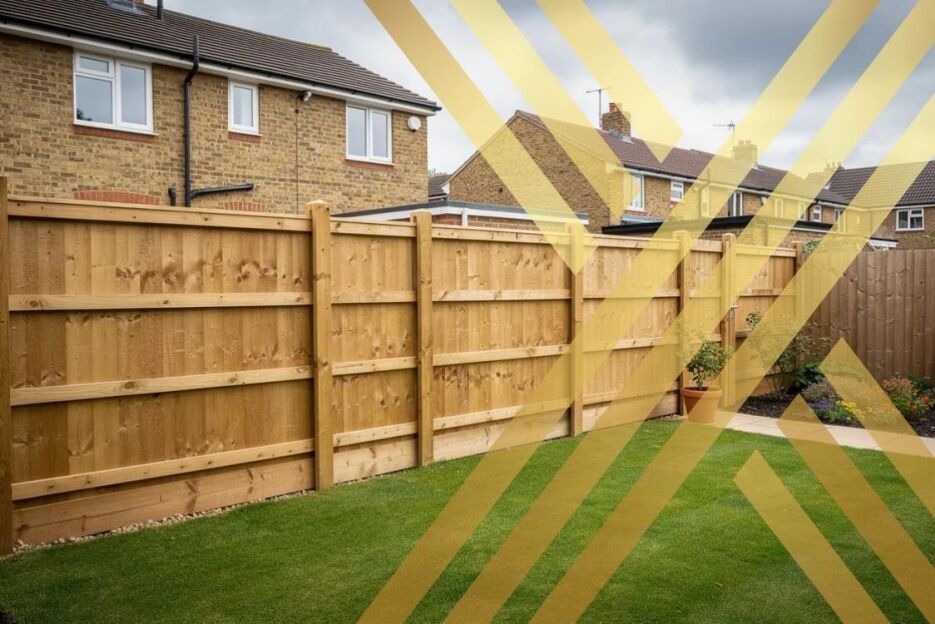
If you are wondering who is responsible for the fence between your garden and your neighbour’s property, you are not alone. Boundary fence law in England and Wales can feel confusing, but the answers are usually found in your property deeds and a few well-established planning rules.
There is no automatic “left-hand fence rule” in boundary fence law. The common misconception that you own the fence on the left hand side when facing the street from the front door has no basis in uk law.
A boundary fence on the boundary line is often a party fence with joint responsibility, particularly where “H” marks or covenants in the title deeds indicate shared ownership. Axis Solicitors can help resolve boundary line and garden boundary disputes anywhere in England and Wales, including Manchester and surrounding areas.
This guide covers ownership, height limits, repairs, disputes and when to get professional help.
Understanding Boundary Fence Law UK in 2026
Boundary fence law in England and Wales is not contained in a single statute. It draws on a mixture of property law, planning rules and principles of neighbourly relations.
Key legislation includes the Party Wall etc. Act 1996, the Town and Country Planning Act 1990, and the Planning (Listed Buildings and Conservation Areas) Act 1990. The Party Wall Act 1996 governs shared boundary disputes involving masonry walls that straddle a boundary. Standard wooden fence panels and garden fences do not fall under this Act.
Garden fence law governs who owns a fence, who must repair it, what fence height is allowed, and when local authority planning permission is required. The law changed very little for domestic fences between 2024 and the 2025/26 period. Current guidance rests on long-standing permitted development rights under the GPDO 2015. Most disputes about a neighbour’s fence arise from uncertainty about the exact boundary line rather than the fence panels or boundary fence law themselves.
Who Owns the Boundary Fence? Deeds, “T” Marks and Party Fences
Ownership of a boundary fence cannot be assumed from which side the fence posts are on or from the left hand side myth. Property deeds often determine fence ownership in the UK, so your documents are always the starting point.
Check the registered title and title plan from HM Land Registry. In 2026, downloading the register typically costs £3 and the plan costs £3 online.
- A “T” mark on title plans pointing into your land generally indicates your responsibility for that boundary fence. A “T” mark on deeds indicates fence ownership responsibility.
- An “H” mark, formed by two opposing “T” marks, indicates a shared boundary where both neighbours are responsible for upkeep and maintenance.
- The absence of a “T” mark does not clarify fence ownership. Many properties registered from the 1960s to 1990s had T-marks in original deeds, but these were never carried into the title register, leaving millions of properties without clear markings.
A party fence sits exactly on the shared boundary line between two properties. It is usually covered by shared upkeep obligations and party wall principles. Where a garden fence is built entirely on one side of the boundary line, it is normally presumed to belong to that landowner unless evidence shows a different written agreement.
Consulting property deeds is important to confirm exact boundary lines before taking action. Older properties or unregistered land may lack clear markings, in which case owners may need a surveyor’s report or legal advice on boundary and title issues from Axis Solicitors.
Common Myths about Fence Ownership
- There is no general rule in boundary fence law that you automatically own the fence on the left or right when viewed from the street. This is a common misconception.
- The “nice” or smooth side of a garden fence facing a neighbour does not prove who owns it. It is convention, not law.
- Paying for an old fence in the past does not always transfer legal ownership if the structure stands on a neighbour’s property.
Property deeds can influence boundary fence ownership and responsibilities according to boundary fence law. Do not rely on assumptions or estate-agent chat. Check your land registry documents and property title deeds instead.
Garden Fence Law, Fence Height and Planning Permission

Garden fence law controls fence height and location rather than forcing anyone to erect a boundary fence. In general, there is no automatic legal obligation in the UK to have a boundary fence around a domestic garden.
- The maximum height for back garden fences is 2 metres without planning permission. Front garden fences next to a highway must be one metre high as per front garden boundary fence law UK..
- The two-metre rule applies to fences without planning permission. Fences over 2 metres require planning permission in the UK under the Town and Country Planning Act 1990.
- Total fence height includes any trellis or toppers added to existing fence panels. A 1.8 metre fence with a 0.3 metre trellis exceeds the height limit and needs consent.
Local authorities may have specific rules for fence installations. Higher fences near listed buildings, road junctions or protected trees will usually require planning permission from the local authority planning department. Requirements may vary depending on your location.
Front Garden, Back Garden and Side Boundary Rules
Front garden fences adjoining pavements or vehicle highways are capped at one metre in height unless planning permission is granted, to preserve sightlines for drivers and pedestrians on public areas.
Back garden and side garden fences away from the highway can typically reach 2 metres without planning permission under permitted development rights. On corner plots, the “front” boundary may wrap around the side where it abuts a street, meaning the height limit of one metre may apply further along than homeowners expect, measured from ground level.
If in doubt about whether a boundary counts as “adjacent to a highway,” contact your local planning officer in writing for advice in boundary fence law before erecting a new fence or gate.
Conservation Areas, Listed Buildings and Open Plan Estates
In certain areas, even minor changes to boundary treatments can require permission.
Height restrictions for fences may differ in conservation areas or for listed buildings. In a conservation area or around a listed building, local authority powers are wider. Even taking down an existing fence, wall or gate can require consent.
Many housing estates built from the 1960s onward were designed with open plan front gardens. Title deeds on these estates often contain covenants banning front boundary fences altogether, regardless of planning rules. Fences in conservation areas may have stricter height regulations.
Planning permission and private covenants are separate. You may comply with planning law but still breach your deeds if you ignore a covenant relating to listed properties or open plan layouts. Check your title register for restrictive covenants of boundary fence law If necessary, ask a solicitor whether the covenant can be varied or released.
Shared Boundary Fence Replacement Law
Boundary fence law addresses who pays for maintenance and when you can act alone.
- If the fence clearly belongs to one neighbour, for example because of “T” marks or its position inside the boundary, that owner is usually responsible for repairing or replacing it. Homeowners cannot force neighbours to repair a fence that is their responsibility.
- In the UK, there is no automatic legal obligation to have a boundary fence. You only must maintain one if required by a covenant, tenancy or special circumstance.
- For a shared or party fence, neighbours often have joint responsibility and should agree in writing how to share repair costs before work starts. Joint responsibility for fence maintenance is common between neighbours.
Where one neighbour refuses to repair a dilapidated boundary fence, the other may erect a new fence just inside their own land. You can build a fence entirely within your own boundary line, provided it complies with planning rules. The owner of a neglected fence may be liable for damage caused if it falls and causes injury to a person or damage to adjoining properties.
Before replacing an old fence or making major changes, record the position of the existing fence with dated photos and measurements. This helps protect you as per boundary fence law.
Painting, Attaching Items and Altering a Neighbour’s Fence
It is illegal to conduct repairs on a fence that belongs to a neighbour without their consent. You cannot lawfully paint, stain, screw into, lean structures against or attach trellis to a neighbour’s fence without express permission. Homeowners must not alter or attach items to a neighbour’s fence without permission. Doing so may amount to criminal damage or trespass and could give rise to a civil claim.
If you erect your own fence inside your garden boundary, you are free to decorate and adapt it as you wish, provided you stay within fence height and planning limits. Where neighbours are happy for each other to attach plants, screening or trellis to an existing fence, put the agreement in writing by email or letter to avoid disputes in boundary fence law.
Boundary Line Disputes and Garden Boundary Solutions

Boundary line disputes can be stressful and expensive if mishandled. Open communication with neighbours can prevent misunderstandings about boundary fence law and protect neighbourly relations before disagreements escalate.
Minor disagreements about boundary fence law often begin when one neighbour moves or starts replacing an existing fence and the other believes the garden boundary has shifted. Check both sets of title documents, historic photographs, old survey reports and physical features such as hedges or walls. A scale plan from Land Registry can help establish where the boundary sits.
A boundary agreement can clarify maintenance responsibilities and the exact line between two properties. Mediation services can help resolve boundary disputes before taking legal action. If informal discussions fail, Axis Solicitors’ civil litigation team can review boundary fence law issues, commission RICS surveyor reports and handle property disputes in Greater Manchester and beyond.
Using Surveyors, Mediation and the Courts
An independent chartered surveyor can produce a boundary report using GPS measurements, Ordnance Survey mapping and Land Registry data to fix the disputed line as per boundary fence law. Professional mediation and dispute resolution give neighbours a neutral forum to record a binding agreement. Mediation can resolve disputes more amicably than court, making it a sensible step before litigation.
Where settlement fails, a claim under Part 8 of the Civil Procedure Rules in the County Court may be required. Understanding the civil litigation process for boundary fence law helps parties prepare for what lies ahead. Courts expect parties to attempt negotiation first. Court action should always be treated as a last resort, as costs penalties can follow if someone rushes straight to litigation.
Practical Tips for Managing Your Garden Fence
- Walk the garden boundary once a year to inspect fence posts, panels and gravel boards, especially after winter storms. Repair small defects early to maintain security and avoid larger bills.
- Record any informal agreements about joint responsibility, boundary realignment or fence height changes in writing, signed and dated by both parties.
- Consider how new fence panels will affect light, views and security for both gardens. Choose designs that balance privacy with neighbourly goodwill.
- Homeowners should check for local authority design guidance and relevant boundary fence law, particularly where estates have a consistent open plan or low-hedge character.
Get Expert Advice on Boundary Fence Law from Axis Solicitors
Understanding boundary fence law does not have to be overwhelming.
The answers to most questions about who owns a fence, who must maintain it, and what height restrictions apply are found in your property deeds, Land Registry title plans and a handful of well-established planning rules. Open communication and written agreements with your neighbours can help you avoid disputes before they arise.
Seeking legal advice is advisable for unresolved boundary disputes, especially where informal conversations have stalled. Because mediation often provides a quicker and less costly route than court. Speak to Axis Solicitors today for expert guidance on boundary fence law, garden boundary disputes and property ownership issues.
FAQ: UK Boundary Fence Law
Can my neighbour force me to put up a boundary fence?
In general, UK law does not require a homeowner to erect a garden fence unless a specific covenant, tenancy term or safety regulation applies. A neighbour who wants more privacy or security cannot usually compel you to build or repair a boundary fence at your expense.
A neighbour may install their own new fence just inside their boundary if they want a barrier and are willing to pay, provided it meets fence height and planning rules. Check your deeds for particular obligations as per boundary fence law. Where a covenant exists, it may be enforceable, and legal advice from a firm such as Axis Solicitors can clarify your position.
Can I increase the height of an existing boundary fence for more privacy?
According to boundary fence law. total garden fence height, including trellis or toppers, is normally limited to 2 metres at the rear and one metre at the front without planning permission. If the existing fence belongs to your neighbour, you must obtain their consent before adding anything to it, even on your side. The fence belongs to them legally.
Consider free-standing screening or a new fence inside your boundary as an alternative if your neighbour refuses permission.
Do I need my neighbour’s permission to replace a boundary fence I own?
If you are the legal owner as per boundary fence law, you do not usually need your neighbour’s consent to replace it like-for-like within your land and within planning limits. Inform your neighbour in advance as a courtesy, especially if workmen need temporary access or plants on the boundary could be affected.
Where a garden fence is jointly owned or treated as a party fence, formal agreement on replacement and cost sharing should be reached before work begins.

